
Our Electoral System is Broken
My main focus in this campaign is to talk about improving the election process in Arkansas. As an economist, I am a firm believer in the idea that competition in the marketplace provides more and better choices for consumers. Most politicians agree with this principle … except when it comes to competition in the marketplace of politics.
Many of our election laws have the effect of restricting competition, and thereby limiting our choices and constraining our ability to select the candidates who might best represent us. The beneficiaries of this system are the incumbents—our elected officials and leaders of the political establishment.
In my experience as Chair of the Libertarian Party of Arkansas, I have had a front-row seat observing how the established political class protect their privileged positions. The result is a chronic lack of competitiveness in Arkansas’ election process.
Arkansas has among the highest rates of voter apathy in the nation. The percentage of voter registration is the lowest in the nation, voter turnout percentages are consistently among the lowest, and the number of uncontested elections is among the very highest. Why bother to vote when there are so few choices?
A Case Study: The Arkansas House of Representatives in 2026
This lack of competitiveness is evident in the dearth of choices in the 2026 elections for the Arkansas House of Representatives:
- In the 2026 general election, only 32 of 100 State House races will have both a Republican and Democratic candidate. Democrats didn’t bother to run candidates in 54 districts. Republicans didn’t contest 14 districts.
- In this year’s primary elections there were only 22 contests for State House seats, on either side of the aisle. Due to gerrymandering those 22 primaries “elected” 14 legislators who now face no opposition in November.
- In all, 54 candidates for State House faced no primary opponent and will have no major-party opponent in the November elections. They were prepared take their seats as our representatives, having paid their filing fees to their respective political parties, without receiving a single vote in a primary election or in the general election.
- Libertarians will provide the only alternative for voters in in four of the districts where the incumbent faced no other opposition. Independent candidates will challenge two more otherwise-uncontested candidates.
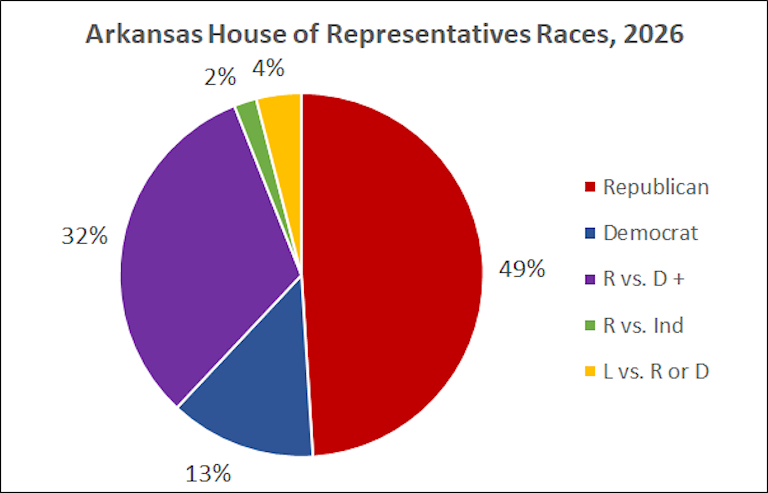
- Bottom line: 49 Republicans and 13 Democrats are already elected. In 32 races the Republicans and Democrats will face off in November (with a lone independent candidate in the mix). Two republican incumbents will be challenged by independent candidates. In four other races, Libertarians will be the only opposition to a Republican incumbent (3) or a Democratic incumbent (1).
Election Reform Proposals
I have several suggestions that would help make elections in Arkansas more competitive. None of these ideas can be adopted unilaterally by the Secretary of State. They would require legislation. I’m not running on the promise of adopting these reforms. I’m asking for you to vote in favor of the principle of opening up our political process and restoring the sovereignty of the people over their government. Your vote for me and other Libertarian Party candidates can send a message to the political establishment that we deserve more and better choices.
Regnat Populus.

- End Gerrymandering
The two major parties have corralled us into distinct constituencies where the parties can choose our representatives. We should have a nonpartisan redistricting commission that uses strictly non-political standards to define legislative districts.
- Reform the primary process
Part of the tradition of one-party rule is the idea that primary elections have exaggerated importance. This year, the Republicans limited participation in their primary elections. In doing so, they make an important point: The primaries are intended to give the political parties a process for selecting their candidates for the general election. Their rules are controlled by the parties themselves. So why are the taxpayers paying for them? We should end taxpayer support of primary elections, and disengage the election calendar from the whims of the parties’ candidate selection processes.
- Change the election calendar
Our primary elections and deadlines for filing are way too early! In 2015 the legislature moved to primary election date from May to March, in order to have a Super-Tuesday primary. Now they’ve made that change apply to every election. Why? Because it protects incumbents. In order to file to run for office with one of the two major political parties, or even as an independent, someone has to commit a full year in advance of the general election. Citizens should be able to step up to run for office on a more appropriate timeline—at least until after the legislature has finished its fiscal session. - Reform the rules for independent candidates
In Libertarian Party of Arkansas v. Thurston, the Libertarian Party won a major victory in overturning many of the restrictions on the formation of “new” political parties. Yet some of the obstacles that federal courts deemed unconstitutional in our case are still on the books restricting ballot access for independent candidates. As it stands, independent candidates must file a year in advance, then collect signatures during a narrowly-defined window in the middle of the winter. No wonder there are so few independent candidates on the ballot in this year’s election.
- Adopt ranked-choice voting
A principle of the democratic ideal of majority rule is that a decisive election requires a majority of the voters to approve. In Arkansas’ primary elections, that requires a run-off election if there are more than two candidates and none receives a majority of votes. A more efficient way of doing things would be for voters to rank their choices, and the second-choice of voters is then counted after the lowest-vote candidate is eliminated. It’s just like a run-off, but built into first round of voting.
Arkansas election laws require run-off elections for primary elections but not for the general election. In a rigidly controlled two-party system there is no need. Choices are already restricted to two, at most, or so the assumption goes. In 2025 the legislature banned the use of ranked-choice voting. That’s how much the idea of allowing more choices on the ballot scares the entrenched political establishment. - Allow access for other political parties.
The Libertarian Party of Arkansas has been certified as a “new” political party for eight consecutive election cycles. This has required our party to collect petition signatures every two years in order to have our candidates appear on the ballot (plus two federal lawsuits to protect even that opportunity). The problem is the next step: becoming an established party. Current law requires 3% of the vote in either the gubernatorial or presidential election, depending on which year it is. This is an unduly restrictive definition that fails to recognize the value of a political party in down-ballot races, nearer to the grassroots.
The Libertarian Party has long advocated a more expansive criterion: 3% of the vote in any statewide election. Our initiative is presently embodied in a proposed Political Party Recognition Act.
The Political Party Recognition Act
The Arkansas election laws provide an avenue for new political parties to form. It’s not an easy process, but it’s possible. Only two parties — the Green Party in 2006-2014 and the Libertarian Party in 2012-2026 — have qualified. And yet, in none of those elections has the “new” political party been able to surpass the 3 percent threshold for governor or president. It’s difficult to persuade voters to overcome the perception of binary choice that is ingrained in our system and in our mindset, especially at the top of the ticket.

The Libertarian Party of Arkansas has consistently argued in favor of legislation to revise the definition of an established political party. We propose that a party should retain its ballot-access status if it receives at least 3 percent of the vote in any statewide race. Because there are some election cycles where there are no statewide races other than president, the ballot retention should last for two electoral cycles. This is essentially the same system used in other neighboring states, for example — Oklahoma with a 2.5 percent threshold and Missouri with a 2 percent threshold.
The enabling legislation would be simple. Here’s what it could look like: The Political Party Recognition Act
This year, vote different. Vote Libertarian.
Tell the established politicians that we demand more and better choices.